

Flight Attendant Salary: You have all the data available to make a decision or not about entering a career in the skies, and you demand an accurate picture of what your pay actually works up to based on experience, airline, base location, and route type (short haul vs long haul). The guide covers pay figures in detail, including entry-level pay vs. experienced pay, where the years of experience put a driver within the ranges of income across regions, and overtime differences among carriers that keep those earnings high or low.
Flight attendants are the safety, service, and emergency procedure providers on board commercial airlines, and it is a combination of insane hours with a compensation model that looks nothing like an0001 hour desk-based job. Grasping how pay actually works, such as flight hours, per diem, and seniority, assists potential attendants and current crew in establishing realistic expectations of their wages.
National Average Flight Attendant Salary
By the nature of their work, average pay at the national level for pilots in the United States can be anywhere between $45,000 and $55,000 a year on the low end, but it varies greatly with seniority and the airline. Many new hires come in well below this average, and upward-bound attendants at a major carrier with 10 or more years of seniority can earn far beyond it.
Unlike the majority of hourly jobs in this field, where any hours spent at the airport, such as time waiting around during a layover, count against total pay, here nearly all pay is based only on actual flight hours. Their monthly earnings can vary wildly due to how many trips are flown, making the annual average a more relevant yardstick than any single paycheck.
Flight Attendant Salary by Experience Level
Seniority is more important in this profession than in almost any other career. As your tenure with an airline grows, pay tends to increase gradually and predictably:
- Year 1 (probation): Usually between $28,000 and $32,000 per year because new hires are paid at the lowest pay scale and often with reserve schedules.
- Years 1-3: Generally about $32k to $40,000 per year as flight attendants escape probation and have improved scheduling availability.
- Years 4- 9: Typically $40,000 to $55,000 per year; high billable rates and ability to be picky about trips.
- 10 years or more: Up to $55,000 to $80,000 a year; especially pursers and leads on overseas flights.
It also demonstrates why first-year pay rarely tends to reflect future earning power; the pay scale is based around seniority much more than most ground-based roles.
Flight Attendant Salary by Airline Type
The airline category has a huge impact on salary since route networks, contract terms, and union accords vary widely. Best international carriers (e.g., Delta, United, and American) normally pay well above the industry standard, generally holding all awarded routes at a high ratio per hour for respective long-haul international destinations. For example, regional airlines and low-cost carriers typically pay more toward the bottom of the national range, especially for attendants in their first few years.
Although cargo carriers and charter operators make up a much smaller part of the picture, compensation models are often vastly different than passenger airlines. Wages at a major legacy carrier can run 20 to 40 percent higher than those of the same seniority level working for a regional airline, mostly because of better union contracts and higher flight pay rates per hour.
Read Also: Patwari Salary
Factors That Influence Flight Attendant Salary
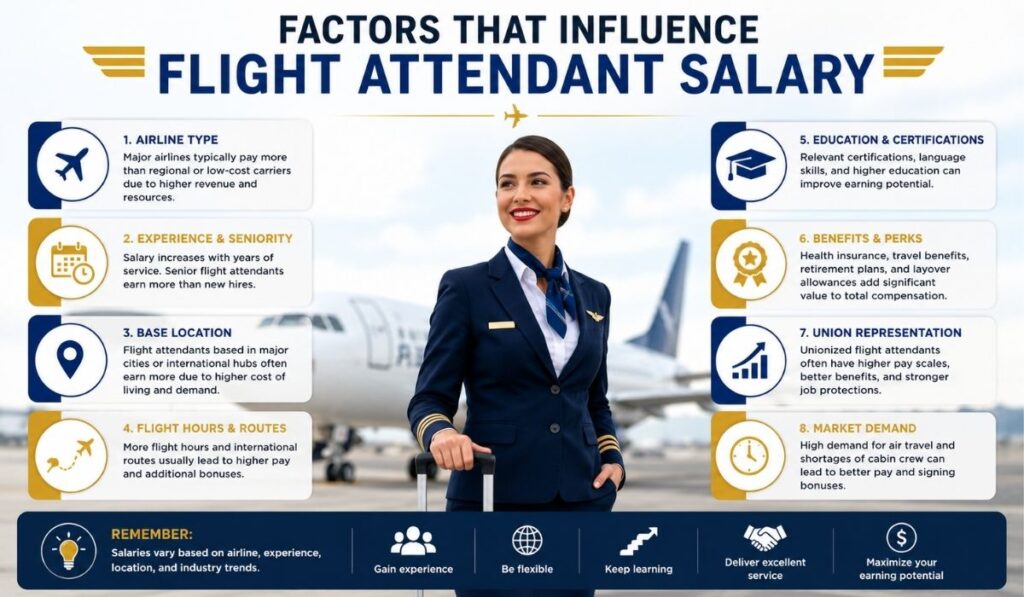
Many factors contribute to the place of a Flight Attendant Salary in the above.
- Seniority and Union Contract: Airlines with a strong union presence can bargain for higher per-hour rates, as well developing better raises over time.
- Base location: Having attendants in high-cost cities may sometimes receive a locality adjustment, but the amount of that varies widely depending on the airline.
- International vs. domestic routes: International flights generally come with a higher hourly pay and more per diem in foreign willing to mean an increase in total compensation.
- Language skills: Speaking a second language gives attendants eligibility for language-differential compensation, especially if the language is one used on international routes.
- Purser or lead duties: Serving as the lead flight attendant on a specific trip generally comes with a small per-flight premium.
- Per diem and expense reimbursement: While these are not strictly base pay per se, layover per diem has a materially significant impact on overall take-home amounts.
Flight Attendant Salary Compared to Related Roles
It also puts the salary information in context with other similar jobs in the travel and hospitality industry. Ground crew and gate agents make significantly less on average, while commercial pilots earn significantly more money because of the higher training and certification necessary. Flight attendants occupy a sort of middle tier: they require specialized safety training and FAA certification but not years of flight training as pilots do, and pay in that role typically reflects the airline industry pay hierarchy.
Sample Flight Attendant Salary Breakdown
Below is a table with typical annual statistics and flight-hour pay rates, highlighted by seniority levels, for quick reference on how your salary could change from the start of your career to the long term.
| Seniority Level | Annual Salary Range | Approx. Hourly Rate | Typical Profile |
| First year (reserve) | $28,000 – $32,000 | $24 – $27 | Probationary, on-call schedule |
| Years 1-3 | $32,000 – $40,000 | $27 – $32 | Off probation, more flexibility |
| Years 4-9 | $40,000 – $55,000 | $32 – $40 | Higher rate, trip selection control |
| Years 10+ | $55,000 – $80,000 | $40 – $55+ | Purser/lead, international routes |
| International routes | +10% – 25% | +$3 – $8/hr | Any seniority, long-haul trips |
| Major legacy carrier | $45,000 – $80,000 | $28 – $55+ | Strong union contract |
How to Increase Your Flight Attendant Salary
Building this pay over time basically boils down to 3 strategic moves versus waiting for step increases based on seniority.
- Grow your seniority intentionally: Since pay scales tend to be the most tenure-based throughout this industry, being with a single airline for a prolonged period tends to be the biggest driver of rising compensation-related success.
- International flights: Finally, you can bid on long-haul international routes that tend to pay better ($$$/flight hour) for each flight than short domestic hops.
- Seek work as a lead or purser: Becoming the employee in charge during flights will often get you a per-trip pay incentive.
- Get a second language qualified attendants are paid differential pay on routes where it’s needed.
- Participate in or support union negotiations: Airlines with open contracts are often more predictable in terms of salary and raises than non-union counterparts, which frequently see larger raises over time.
- Record flight hours: Learning the scheduling and bidding process is essential to getting in premium flying time, as pay per hour flown means every minute counts!
Flight Attendant Benefits Beyond Base Pay
In this industry, base pay is just one small piece of the compensation puzzle. Most airlines provide travel benefits to attendants, including free or heavily discounted flights for the attendant and eligible family members, which can greatly ameliorate relatively low early-career pay. Health insurance, retirement matching, and per diem for layovers round out a package that, once these extras are considered, often looks more competitive.
Particularly, per diem should be focused on since whilst flying is key, you are paid for every hour away from base (layovers etc) not just in the air. Per diem, which is usually listed as a separate category and not factored into the results shown by most job postings when advertising pay rates, can add hundreds of dollars to total earnings over a busy month!
Read Also: RAW Agent Salary: Pay Scale, In-Hand Salary
Understanding Reserve Status and Its Effect on Pay
New hires generally work for their first year or more as a reserve, that is, by being on call to cover trips rather than having a set, pre-bid schedule. Because reserve attendants are poised to fly but may not actually operate flights on a given day, the pay is typically calculated based on guaranteed minimum hours instead of actual hours flown. That guarantee gives some income stability through the least-well-defined portion of a career, but it also creates circumstances where reserve-year earnings are at the back of the bottom in the pay chart regardless of how many hours an attendant is technically on call.
But there are few lines more representative of a career than moving off when attendants can bid on specific trips, routes, and days off. Not only does this extra control give attendants a better quality of life, but it also allows for higher-paying international routes to be prioritized, as well as premium trips that schedules reserved usually do not grant.
International Layovers and Per Diem Currency
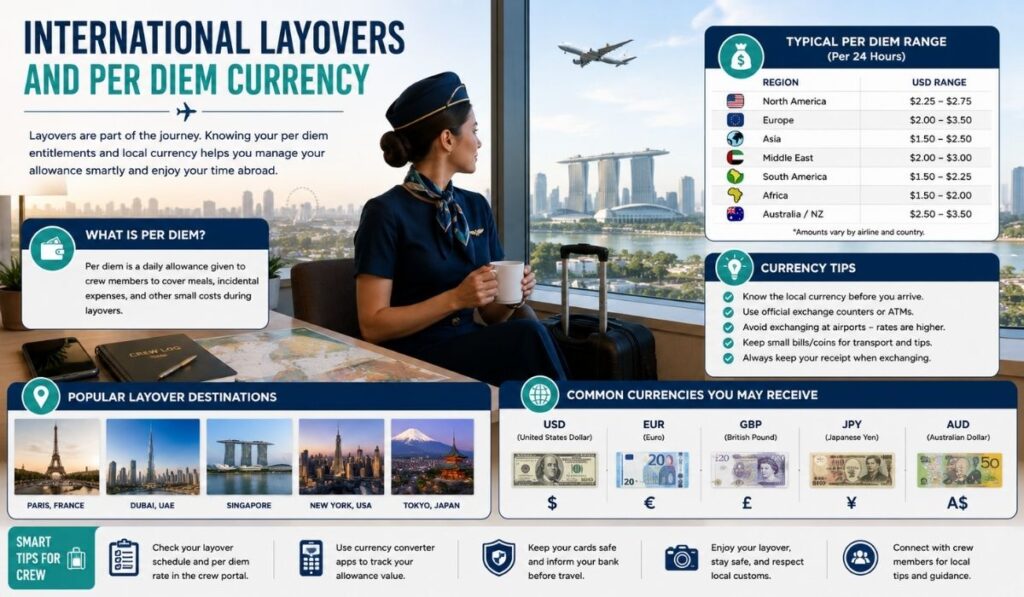
International routes have other complications that would add more layers to raising your understanding. International trip per diem is occasionally paid in the layover city’s local currency, meaning that exchange rates can give you an almost imperceptible bump or drag on real earnings from month to month. Even the attendant on a plane that flies routinely to destinations where currency exchange rates work in their favor sometimes realizes some small amount of effective take-home value for their efforts and sacrifice, since the per-hour rate appears comparable to one on a domestic route.
Layover length also matters. Because it accrues based on time away from base and not just in-the-air time, the average total per diem for longer international layovers will typically be higher. When choosing trips, attendants constructing a bidding strategy focused on maximizing compensation will consider not just flight hours but also layover times.
Job Outlook for Flight Attendants
Anyone considering a career decision should also care about the long-term future of pay in the profession beyond current figures. Demand for air travel has climbed steadily in the last decade, and airlines keep growing routes and airplanes to satisfy that demand, which is helping continued hiring among various large carriers. However, due to the slow increase in pay (in comparison to other industries), the profession has remained fairly stable.
While a sudden rise in demand does not necessarily lead to an enormous jump in any given year’s pay, it means that attendants who stay with a carrier long enough to accrue seniority seldom run out of flying. That type of stability is why so many attendants treat the first few years like a footing-building period instead of as they continue their early paychecks across a long career.
What to Expect During Salary Negotiations
Because the vast majority of terms are set out in union contracts or dictated by seniority systems, negotiating pay this way looks different from what it does in most other careers. Some useful actions are still:
- Review Pay per AirlineCarrier pay scales differ quite a bit, so knowledge of an airline’s published pay scale is worth more than percentages, as there are no national averages.
- Read the current CBA: To clarify exactly how raises, per diem, and route bidding work, one must read the CBA.
- Degree to which upgrade paths are available: By knowing how pursers or lead positions are allocated, attendants can develop a strategy for future per-flight pay increases
- Stay on top of industry pay trends: The news related to airline contract negotiations allows you to set reasonable expectations for future raises.
- Weight switching carriers: a move to a new airline often resets seniority, mitigating the wiggle in pay in the near term.
Salary vs. Cost of Living
Even though it looks high on paper, it does not relate to more disposable income. Even if two attendants have the same pay on paper, one based in a larger city where everything is more expensive to live – rents, food, utilities – may ultimately have less disposable income (or purchasing power) as compared with a peer in a smaller market. Well, when comparing base assignments in various cities, it can be more helpful to measure the number listed against elements such as cost of housing, commuting costs, and state tax rates.
Read Also: TA Army Salary
Common Missteps That Cost Money
Some preventable behaviors silently limit earning power for otherwise able attendants. Switching airlines whenever they want without considering the loss of seniority is one of the most common pitfalls, as restarting on a scale can erase many years’ worth of hard work. Excluding per diem and travel amenities while comparing offers is another, because these addenda are significant elements of total pay. And lastly, taking a base assignment without understanding the local cost of living can help trap an attendant into having far less spendable income than a lower headline number in a more affordable city.
Frequently Asked Questions: Flight Attendant Salary
What is the average flight attendant salary in the United States?
The average flight attendant salary nationally falls between $45,000 and $55,000 per year, though this varies significantly by airline, seniority, and route type.
Does seniority really affect flight attendant salary?
Yes. Seniority is the strongest single factor in this profession, and a flight attendant salary can more than double between the first year and a tenured position of ten or more years.
Which airlines offer the highest flight attendant salary?
Major international carriers with strong union contracts, such as Delta, United, and American, generally report the highest flight attendant salary figures, particularly for long-haul international routes.
How does a flight attendant salary compare to a pilot’s pay?
A flight attendant salary typically sits well below a commercial pilot’s pay, reflecting the extensive additional flight training, licensing, and flight hours required to become a pilot.
Can a flight attendant salary grow without switching airlines?
Yes. Building seniority, bidding for international routes, pursuing purser or lead positions, and learning a second language can all raise a flight attendant salary without requiring a move to a new career.
Conclusion About Flight Attendant Salary
Flight attendant salary is almost exclusively tied to experience, airline, type of route, and the individual terms in a union contract – but with very few exceptions across the industry flight attendants salary can expect their pay rates to follow an easy-to-predict upward track over time if they stay at one carrier. Regardless of whether you are new to the profession or considering an offer for overseas routes, knowing where your flight attendant salary lands vs. the industry average is half the battle in a career path that should be driven by aviation intelligence.