Student studying govt exams and preparing for the continuing search engine keyword “SDM full form” because SDM is one of great top most administrative service positions. SDM: The post of Sub-Divisional Magistrate (SDM) was available and this is the a lot responsible position that dealing with all public administration work at subdivision level.
SDM officers come to the attention of people when it comes to administration, law and order, land-related matters and government schemes. But most of us are not aware about all the facts for this post.
Through this comprehensive article, we will explore everything that you need to know regarding SDM including its definition, eligibility criteria, salary structure, roles and responsibilities, power as well as how to become an SDM Officer.
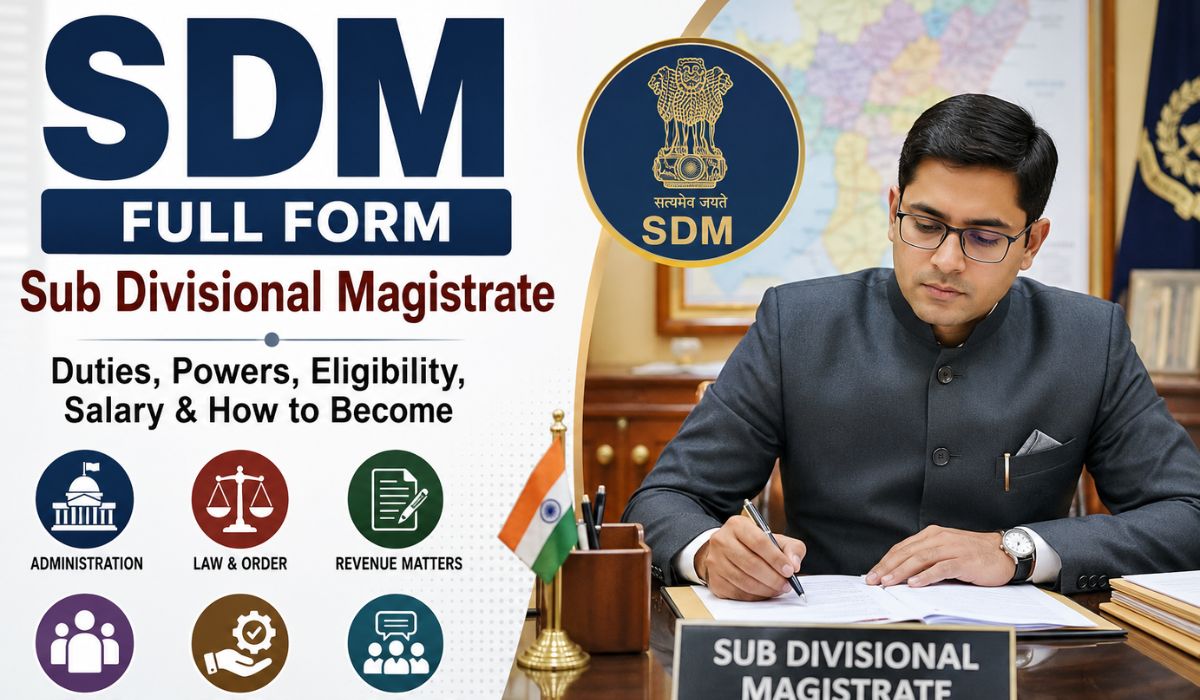
SDM Full Form
The SDM full form is Sub Divisional Magistrate.
Sub Divisional Magistrate is a government officer, who deals with the administrative work within a subdivision of district. The SDM works in the district level and belongs to state administrative Service cadre under District Magistrate.
The SDM post is considered one of the important positions in the state administration system.
Basic Information About SDM
| Particular | Details |
|---|---|
| Full Form | Sub Divisional Magistrate |
| Department | State Administration |
| Reporting Authority | District Magistrate |
| Job Type | Government Administrative Service |
| Work Area | Subdivision of a District |
| Selection Process | UPSC or State PSC |
| Category | Gazetted Officer |
What Does an SDM Do?
An SDM performs various administrative functions in a subdivision. The officer ensures smooth operation of government activities and public services.
Some major responsibilities include:
- Maintaining law and order
- Handling land and revenue matters
- Monitoring government schemes
- Supervising elections
- Issuing certificates and licenses
- Managing disaster situations
- Solving public grievances
- Coordinating with local departments
The position requires decision-making abilities and administrative skills.
Main Duties of an SDM Officer
The duties of an SDM officer are broad because they deal with multiple government functions.
1. Revenue Administration
The SDM supervises revenue collection and land records.
Responsibilities include:
- Land mutation
- Property disputes
- Revenue collection
- Land acquisition matters
2. Maintaining Law and Order
An SDM plays an important role during emergencies and public issues.
Activities include:
- Managing public gatherings
- Handling sensitive situations
- Taking preventive measures
- Coordinating with police authorities
3. Public Welfare Activities
Government schemes are monitored by administrative officers including SDMs.
Examples include:
- Housing schemes
- Education programs
- Health initiatives
- Social welfare projects
4. Election Responsibilities
During elections, an SDM handles:
- Election management
- Polling arrangements
- Monitoring election activities
Read More: CRPF Salary / Google CEO Salary / Veterinary Doctor Salary
Powers of an SDM Officer
An SDM receives several legal and administrative powers under government rules.
Important powers include:
| Power | Description |
|---|---|
| Executive Power | Implements government policies |
| Revenue Power | Handles land and revenue matters |
| Judicial Power | Exercises limited magistrate powers |
| Administrative Power | Supervises local administration |
| Emergency Power | Handles crisis situations |
The officer can take important decisions to maintain public order.
Eligibility Criteria to Become SDM
Students interested in becoming SDM officers must satisfy educational and age requirements.
Educational Qualification
Candidates must possess:
- Graduation degree from a recognized university
- Degree can be in any stream
Examples:
- BA
- BSc
- BCom
- BTech
- Any equivalent degree
Age Limit
Generally, age criteria are:
| Category | Age Limit |
|---|---|
| General | 21–32 years |
| OBC | Age relaxation available |
| SC/ST | Additional relaxation available |
Age limits may vary depending on state government recruitment rules.
How to Become an SDM?
There are mainly two methods for becoming an SDM officer.
Method 1: Through UPSC Civil Services Examination
Candidates can appear for the UPSC examination.
Process:
Step 1:
Complete graduation.
Step 2:
Apply for Civil Services Examination.
Step 3:
Clear preliminary examination.
Step 4:
Clear mains examination.
Step 5:
Pass personality interview.
Step 6:
Receive training and posting.
Method 2: Through State Public Service Commission
Many states recruit officers through State PSC examinations.
Examples include:
- UPPSC
- BPSC
- MPPSC
- RPSC
- HPSC
Selected officers can later be appointed as SDMs.
SDM Selection Process
The selection process generally includes three stages.
| Stage | Process |
|---|---|
| Stage 1 | Preliminary Examination |
| Stage 2 | Main Examination |
| Stage 3 | Interview |
Candidates who perform well in all stages receive final selection.
SDM Salary Structure
The salary of an SDM officer depends upon state rules, pay level, and allowances.
Average salary details are given below:
| Salary Component | Approximate Amount |
|---|---|
| Basic Salary | ₹56,100–₹1,77,500 |
| Dearness Allowance | Applicable |
| House Rent Allowance | Applicable |
| Travel Allowance | Applicable |
| Other Benefits | Government facilities |
The approximate monthly salary usually ranges between ₹60,000 to ₹1,00,000+ depending on the location and benefits.
Benefits Given to SDM Officers
Apart from salary, officers receive additional facilities.
Major benefits include:
- Government residence
- Official vehicle
- Security support
- Medical facilities
- Pension benefits
- Telephone allowances
- Travel facilities
These benefits make the post highly attractive among government job aspirants.
Read More: Intelligence Bureau Security Assistant Salary / Station Master Salary /
Skills Required to Become an SDM
A successful SDM officer usually develops several important skills.
Required skills include:
Leadership Skills
Managing teams and administration effectively.
Decision-Making Ability
Quick decisions are often required during emergencies.
Communication Skills
Interaction with citizens and departments is necessary.
Problem Solving Skills
Complex administrative issues need practical solutions.
Time Management
Handling multiple responsibilities efficiently.
Difference Between SDM and DM
Many people confuse SDM and DM positions.
The following table explains the difference:
| Basis | SDM | DM |
|---|---|---|
| Full Form | Sub Divisional Magistrate | District Magistrate |
| Area Managed | Subdivision | Entire District |
| Authority Level | Lower | Higher |
| Reporting Structure | Reports to DM | Heads District Administration |
| Responsibilities | Local administration | District administration |
Why Many Students Choose SDM as a Career
Several reasons make the SDM position popular:
- Respect in society
- Good salary
- Administrative authority
- Job security
- Career growth opportunities
- Public service opportunities
The position offers both responsibility and stability.
Conclusion
SDM full form is Important For Exam Students who prepare for civil services and government exam. Sub Divisional Magistrate — A Sub Divisional Magistrate is charged with administration, public welfare, land acquisition and law & order related work for a subdivision. It gives Authority, Career Growth, Job Security and Opportunity to serve Society.
As SDM is a very reputed post in government sector hence can be an good option for candidates who wants long-term profits and develop their professional career.
FAQs
Q. What is the SDM full form?
The SDM full form is Sub Divisional Magistrate.
Q. Can a 12th pass student become SDM?
No. Graduation from a recognized university is required.
Q. What is the minimum age for SDM?
The minimum age is generally 21 years.
Q. Is SDM a government job?
Yes, SDM is a government administrative position.
Q. Who has more power, SDM or DM?
The District Magistrate has higher authority than an SDM.