Health-related expenses are part of everyday life, and the government offers some tax benefits designed to ease this burden. One such advantage is exemption of the medical allowance. A sizeable portion of salaried employees is given medical allowance on a regular basis as part of their salary package but are confused whether it gets taxed or stay exempt from tax.
It is important to know about the rules regarding medical allowance as it directly influences the income tax you pay. Here is our way of explaining medical allowance exemption in very simple words so that it can be understood by anyone.
What is Medical Allowance?
Medical allowance is paid by an employer to their employee on a monthly or yearly basis, as a fixed amount to help the employee with basic health needs. It is also a part of the employee’s salary structure and has mentioned in the salary slip generally.
Employers offer this allowance for employees to take care of their health expenses like visiting a doctor, medicines, and treatment cost.
But workers often believe this allowance is tax free, and that’s not always the case. The tax treatment will vary based on the nature of the payment and relevant tax regulations.
Medical Allowance vs Medical Reimbursement
There are a lot of people who get confused between medical allowance and medical reimbursement. While these terms may be used interchangeably they are treated differently in tax law.
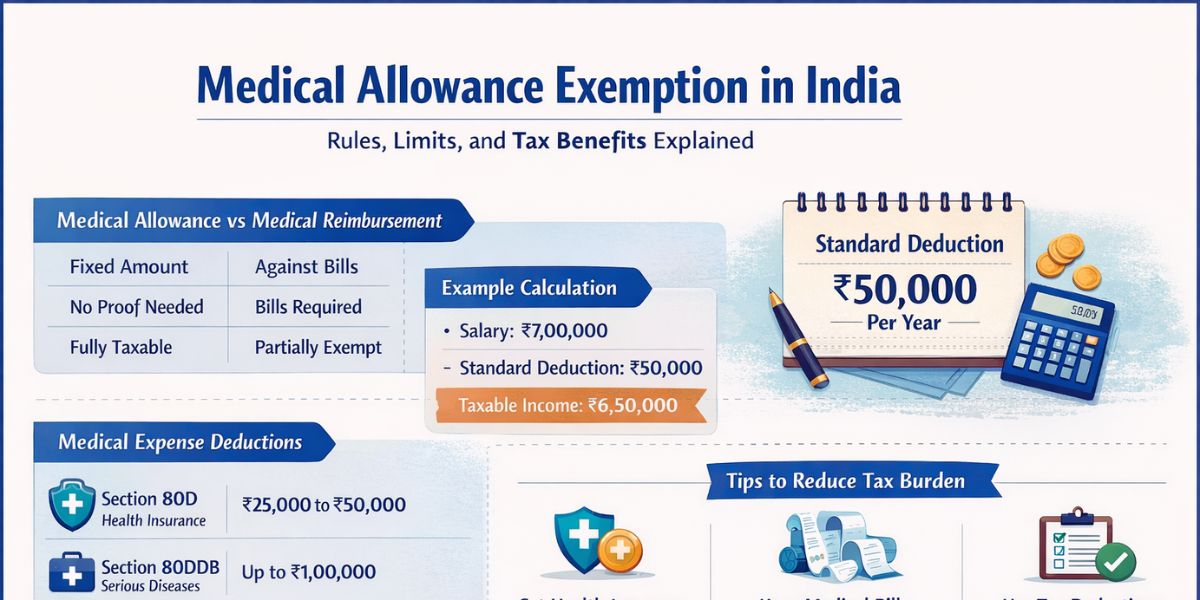
| Feature | Medical Allowance | Medical Reimbursement |
|---|---|---|
| Payment Type | Fixed amount given with salary | Payment made against actual medical bills |
| Proof Required | No proof required | Bills and prescriptions required |
| Tax Treatment | Fully taxable | Certain exemptions may apply |
| Payment Frequency | Monthly or annually | Whenever medical expenses occur |
In simple terms, medical allowance is a part of salary, while medical reimbursement is a repayment of medical expenses.
Is Medical Allowance Exempt from Tax?
Under current income tax rules in India, medical allowance is fully taxable. This means the amount received as medical allowance is added to your salary and taxed according to your income tax slab.
Earlier, there was a provision for medical reimbursement exemption up to ₹15,000 per year. However, this rule changed after the introduction of the standard deduction.
Today, most employees receive the benefit through standard deduction instead of medical reimbursement.
Read More:
Standard Deduction and Medical Benefits
The government introduced standard deduction to simplify tax calculations for salaried employees.
Currently, salaried individuals can claim a standard deduction from their salary income without submitting any bills.
| Particular | Amount |
|---|---|
| Standard Deduction | ₹50,000 per year |
| Applicable To | Salaried employees and pensioners |
| Documentation Required | No documents required |
This deduction replaced earlier exemptions like transport allowance and medical reimbursement.
So, instead of claiming medical allowance exemption, employees now benefit through standard deduction.
Read More: IAS Salary After 10 Years / Software Engineer Salary / CA Full Form
Example of Medical Allowance Tax Calculation
Let us understand the tax impact with a simple example.
| Salary Component | Amount (₹) |
|---|---|
| Basic Salary | 5,00,000 |
| House Rent Allowance | 1,50,000 |
| Medical Allowance | 20,000 |
| Other Allowances | 30,000 |
| Total Salary | 7,00,000 |
Since medical allowance is taxable, it will be included in total income.
Now apply standard deduction.
| Calculation | Amount (₹) |
|---|---|
| Total Salary | 7,00,000 |
| Standard Deduction | 50,000 |
| Taxable Income | 6,50,000 |
This shows that medical allowance does not receive separate exemption anymore.
Who Receives Medical Allowance?
Medical allowance is usually provided to the following categories of employees:
- Government employees
- Private sector employees
- Corporate professionals
- Contract employees (in some cases)
The allowance amount depends on the organization’s salary policy. Some companies provide ₹1,000 to ₹2,000 per month, while others include a higher amount.
Benefits of Medical Allowance
Even though medical allowance is taxable, it still provides certain benefits.
1. Financial Support for Medical Needs
Employees can use the allowance for medicines, doctor visits, and treatment expenses.
2. Fixed Payment
Unlike reimbursement, employees receive the amount regularly without submitting bills.
3. Simple Salary Structure
Employers often include it in salary packages to provide additional benefits.
Limitations of Medical Allowance
There are also some limitations associated with medical allowance.
Fully Taxable
The biggest disadvantage is that medical allowance does not qualify for tax exemption.
Not Linked to Actual Expenses
Employees receive the same amount regardless of their medical expenses.
Less Useful for Tax Planning
Since it is taxable, it does not reduce the tax liability directly.
Medical Expense Deductions under Income Tax
Even though medical allowance exemption is not available, taxpayers can still claim deductions for certain medical expenses under other provisions.
| Section | Purpose | Maximum Deduction |
|---|---|---|
| Section 80D | Health insurance premium | ₹25,000 to ₹50,000 |
| Section 80DDB | Treatment of specified diseases | Up to ₹1,00,000 |
| Section 80DD | Disability of dependent | ₹75,000 to ₹1,25,000 |
These deductions can help reduce taxable income significantly.
Medical Allowance in Government Jobs
In many government jobs, medical benefits are structured differently. Instead of simple allowances, employees may receive:
- Medical reimbursement
- Health insurance coverage
- Government hospital treatment
- Cashless medical facilities
This provides better healthcare support compared to a simple allowance.
Tips to Reduce Medical Tax Burden
Employees who want to manage medical expenses efficiently can follow these tips:
Maintain Health Insurance
A good health insurance policy allows you to claim deductions under tax laws.
Keep Medical Bills
If your employer offers reimbursement, keeping bills will help you claim benefits.
Understand Salary Structure
Check whether your salary includes medical allowance or reimbursement.
Use Tax Deductions
Sections related to health insurance and disease treatment can reduce taxable income.
Future of Medical Allowance in India
Over the years, the government has simplified tax rules by replacing multiple small exemptions with standard deduction. Because of this, traditional exemptions like medical reimbursement have become less important.
Experts believe that salary structures will continue to move toward simpler tax systems where allowances may gradually reduce.
However, employers may still include medical allowance in salary packages for employee welfare.
Read More: Lawyer Salary / CA Full Form / 3 LPA In Hand Salary Per Month
Conclusion
Although medical allowance is a common part of many salary structures, it is imperative to comprehend its tax treatment. Currently, there is no exemption for medical allowance and the entire amount received as medical allowance is taxable.
The salaried employees can now claim a standard deduction of ₹50,000 which simplifies the tax calculations and provides relief without any documentation instead of separate medical exemptions.
Although medical allowance does not directly lower tax liabilities, employees can still claim deductions for health insurance and medical expenditures. The details contained in these rules can help people with their personal finances and budgets and plan manage health care costs.
FAQs
1. What is medical allowance exemption?
A. Medical allowance exemption refers to the tax benefit related to medical payments from employers. However, under current rules, medical allowance itself is fully taxable.
2. Is Medical Allowance Exemption taxable in India?
A. Yes, Medical Allowance Exemption is fully taxable and is added to the employee’s salary income.
3. What replaced medical reimbursement exemption?
A. The government replaced medical reimbursement exemption with a standard deduction of ₹50,000 for salaried individuals.
4. Can employees claim medical bills for tax exemption?
A. Employees can claim deductions for health insurance or specific diseases under other income tax sections, but not for medical allowance.
5. What is the difference between Medical Allowance Exemption and reimbursement?
A. Medical Allowance Exemption is a fixed salary component, while reimbursement is payment made after submitting medical bills.