
Introduction
There are many young engineering professionals who have discovered that no matter how good their credentials may be, their salary growth has stopped and their careers have entered a stagnant phase. Aspiring to earn highly lucrative positions, they still wonder which skills would yield the highest dividends on their investments.
This situation exists owing to a mismatch in the market. While there is an overload of engineers involved in design work, there is a serious shortage of skilled engineers proficient in manufacturing, especially precision CNC machining. This disparity leads to a huge disparity in pay scales. This piece seeks to unravel why precision CNC machining skills play such a pivotal role in raising engineering pay levels and advancing engineering careers.
Why Are Skills Related to Precision Manufacturing Associated with Higher Engineering Pay?
Market scarcity and the ability to add value create the connection between skills related to precision manufacturing and increased pay. The engineers who know how to utilize CNC machining for the manufacture of custom parts and bridge the gap between design and manufacture are getting scarcer and therefore earn higher salaries.
- The Market Scarcity Premium: McKinsey Industry 4.0 trends report says that within the next five years, there will be an unprecedented 50% increase in the demand for employees able to bridge the gap between design and advanced manufacturing. In other words, there is a need for individuals who can bring products to the market at the lowest possible time, lowest cost, and highest quality. Therefore, individuals with skills related to CNC machining will always have high bargaining power when negotiating salaries.
- From Designer to Manufacturing Expert: While an engineer knowledgeable about only one piece of CAD software is limited to a specific phase in the life cycle of products, an engineer familiar with CNC machining techniques will be able to lead from product conception to its manufacture. He or she can foresee possible issues, choose the best CNC machining process comparison, and collaborate effectively with manufacturers. All of this makes such engineers value drivers rather than cost centers. Their salaries should be 20-40% higher because of this skill set.
- Quantifiable Impact on Business Outcomes: An engineer with CNC machining skills can save a company 15-25% in expenses and shorten its development timeframes by several weeks. It is easy to show how it translates into financial benefits. If an engineer demonstrates to the company’s management that due to his or her skills the company was able to save 50,000, araise of 10,000-$15,000 should be quite reasonable for such employees.
Which Type of CNC Machining Yields the Highest ROI for Engineers?
CNC skills vary in their cost efficiency. It is imperative for an engineer to be aware of the cost efficiency ratios associated with various forms of CNC machining, which include turning, 3-axis milling, 5-axis milling, and mill-turn. The ability to utilize the most appropriate CNC machining type for any task will allow the engineer to lower costs considerably.
1. The Basic Decision: Turning vs. Milling
There’s a clear choice between machining processes for simple shapes such as shafts by means of CNC turning, which is less expensive and more rapid than the alternative, CNC milling, which offers more design flexibility but is both slower and more costly. Getting your choice of CNC process wrong can effectively double the price of making an item. This is why knowing the fundamental CNC machining process comparison is key to successful design.
2. The Competitive Edge of 5-Axis Proficiency
5-axis machining stands out as one of the most advanced techniques for machining complex geometrical shapes in one setup without making any mistakes and reducing manufacturing time by half. Knowledge about 5-axes and 3-axes and the ability to make the right choice can save companies money, especially within the aerospace, medical, and automotive industries. For more insights on how various types of machining influence budget planning, see the full guide on CNC machining services that helps engineers to better understand 5-axis milling vs. turning.
3. Mill-Turn: Combining Strengths in One Process
The mill-turn machine represents the best of both worlds in terms of capability and performance, integrating functions of the lathe and milling center to enable manufacture of complex prismatic pieces in one set-up. Such machines are suitable for prismatic parts requiring a high level of precision and accuracy in fabrication. Engineers experienced in multi-process combination machining will be able to streamline production while maintaining tolerances achievable only through this approach. Although other technologies like friction welding may fit certain applications, when it comes to creating complex geometry with unrivaled precision and consistency, CNC machining process comparison will always be at the core of the process.
How Does an Understanding of CNC Cost Drivers Improve Projects and Careers?
Knowledge about costs can be described as an asset. A professional engineer that is knowledgeable on the four factors of cost consideration – geometrical complexities, materials, tolerances, and surface finishes – is capable of making good decisions that ensure value and functionality at the same time.
1. Geometry Complexity: The Dominant Factor in Cost Comparison
Geometrical complexity of part is the biggest determinant in determining CNC machining cost comparison. Geometries that require 5-axis machining, deep cavities, thin walls, or small internal angles would significantly drive up programming time, processing time, and tools required to complete. A competent engineer able to eliminate unnecessary complexities, standardize radii, minimize setups, and avoid superfluous undercuts could save up to 20-30% in cost while preserving functionality. This type of design expertise is an indicator of a senior engineer’s competence.
2. Material and Tolerance Trade-offs
Material choice will affect both cost of raw materials and their processability. Aluminum is relatively cheap and fast to machine; titanium is costly and slow. On top of that, unnecessarily tight tolerances (e.g., ±0.025 mm) may be specified in areas where this is not necessary, thus driving up machining cost. Experience and process knowledge will tell an engineer when to apply tight tolerance specification and when to refrain from doing so.
3. How to Get an Instant Quote for Real-Time Cost-Benefit Analysis
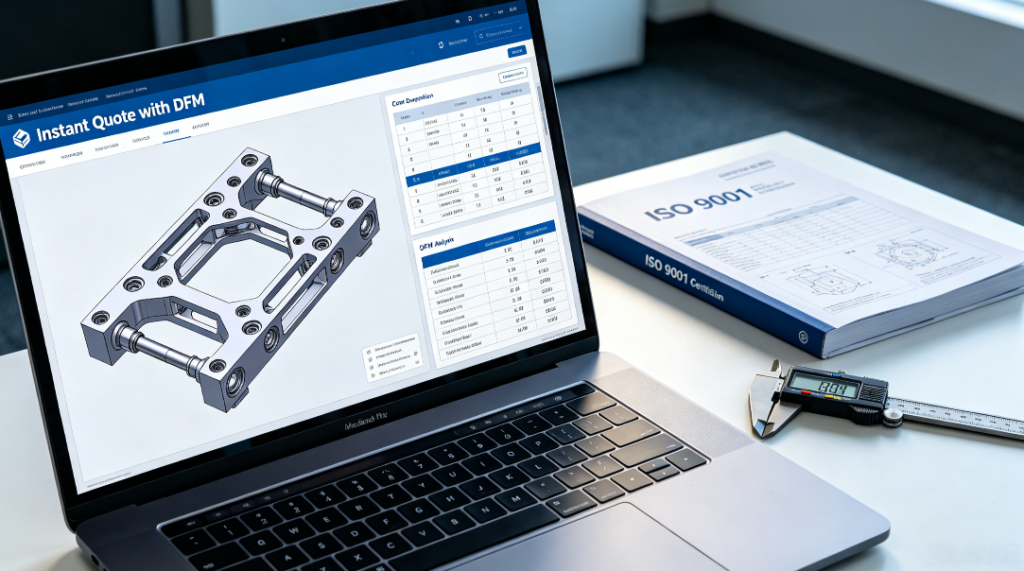
Modern technological tools allow engineers to conduct a cost analysis while designing the product. The upload of a 3D model and an instant quote will provide information on the price consequences of making any changes in the design of the product. In order to make a proper estimation of these variables, without exceeding the budget, skilled engineers use platforms which provide a clear CNC machining instant quote. This provides an opportunity to conduct a cost-benefit analysis in real time, something very appreciated by management teams.
What is the Importance of Certifications such as ISO 9001 in the Process of Supplier Selection?
While choosing a manufacturing partner, certifications do more than prove compliance with international standards; they indicate the presence of a quality-conscious business culture. Knowing how to choose CNC machining supplier selection according to their certifications is essential for engineers who manage outsourced manufacturing processes.
1. ISO 9001: The Standard of Quality Management Systems
The ISO 9001 standard represents an internationally accepted framework for quality management systems. It mandates documentation of procedures for controlling processes, corrective actions, and improvement. According to the official ISO website, ISO 9001 “specifies requirements for a quality management system where an organization needs to demonstrate its ability to consistently provide product which meets customer and applicable statutory and regulatory requirements.” This requirement proves the necessity of working with ISO 9001-certified manufacturers for engineers.
2. Industry Specific Certifications: IATF 16949, AS9100D, ISO 13485
When working within regulated industries, further certification is required. The IATF 16949 (automotive industry) involves APQP (advanced product quality planning), while AS9100D (aerospace industry) requires stringent traceability and risk management. As for ISO 13485, it focuses heavily on risk management and regulation. A competent engineer would understand the difference and know which certification to look out for within that particular industry.
3. Going Beyond the Certification: Auditing the Quality Culture
Certifications are merely a beginning and not a conclusion. An experienced engineer will always want to know, do they offer First Article Inspection? Are they using Statistical Process Control? Have they achieved material traceability? Only then can one be sure of the level of commitment to quality that runs through the organization like a current. This due diligence is a hallmark of the seasoned engineering professional.
Case Study: Using Multiple Process Knowledge to Reduce Cost by 25% in Complex Optical Bracket Machining
There is nothing more powerful than putting theory into practice. This case study will show that in-depth knowledge of manufacturing processes helped to save money for one of our clients, proving the worth of working with an engineer who knows precision CNC machining services.
1. The Problem: Getting Conflicting Quotes for a Precision Lens Barrel Bracket
A manufacturer specializing in optical equipment was looking to get a customized complex aluminum bracket for mounting lenses. It had multiple mounting holes and required precise flatness tolerance of 0.02mm. Quotes received varied greatly from hundreds to thousands of dollars and were confusing in terms of lead time because of insufficient knowledge regarding the process of CNC machining services.
2. The Solution: Integrated Multi-Process Machining
The engineering group at LS reviewed the design of the part and recommended an integrated approach with milling and turning. The datum and end face could be machined with the mill-turn center, while the holes and threads could be produced within the same setup, thus avoiding multiple fixturing issues. While the hourly rate was somewhat higher, the advantages were obvious: there were huge savings on handling and setup, costs were lowered by 25% , lead-time cut by 40%, and the key tolerance of 0.02mm flatness maintained.
3. The Takeaway: Collaborative Engineering Brings Value
The following case study of LS is an example of how collaboration can be used by engineers to achieve something valuable for both parties involved. In particular, thanks to the transition from merely making a quotation to developing a strategy of manufacturing together, the client has obtained a reliable result. It is exactly this kind of value that skilled engineers can create for their companies.
Conclusion
Investment in precision engineering knowledge for engineers interested in career advancements is one of the best decisions that may ensure substantial financial gains and promotion opportunities. It is not just a set of practical skills; it is the mindset that allows transforming ideas into profitable projects. Thus, becoming an expert in precision manufacturing, an engineer will no longer be regarded as a mere resource but rather a valuable asset.
FAQs
Q: Is it true that I can get a raise if I am familiar with CNC machining services?
A: Yes. The design engineers familiar with CNC services and manufacturing know how to minimize costs and lead time. Such experts are very valuable for any company as their competence results in savings and thus leads to a 20-40% salary advantage.
Q: What determines the price of CNC machining services the most?
A: Geometric complexity is key. Features which involve 5-axis machining and small tolerances raise both programming and machining time significantly. Submitting full specifications, including material and tolerance information, is vital for getting an accurate CNC machining services quote.
Q: When should I choose CNC turning over milling for my part?
A: The rule of thumb is symmetry. Turned parts are rotationally symmetric (shafts for example). Milling is for complicated and multi-faceted parts. Recognizing the basic difference between CNC turning and milling is your starting point in selecting the right process.
Q: Should I always go with the lowest CNC machining quote?
A: Not necessarily. Low price means compromise. Proper CNC machining supplier selection process entails assessing certifications (ISO 9001, AS9100D) and quality control process of the partner. The higher quote from your partner will likely turn out more beneficial to you overall.
Q: How can I receive a fast and accurate CNC parts instant quote?
A: Make sure you have a full technical drawing or 3D model including all the required tolerances, material type, and finish. In this case, it will be easy for you to utilize our CNC machining instant quote feature, which will enable you to receive a fast CNC machining quote instantly based on your CNC machining for custom parts requirements.
Author Bio
The above article is written by an experienced manufacturing professional working at an engineering company that helps professionals overcome precision part challenges. LS Manufacturing, a business with ISO 9001, ISO 13485, IATF 16949, and AS9100D certifications, is always dedicated to delivering the best results. If you would like to implement the above approach in your own project, it is high time you got started with the DFM analysis and received a CNC machining instant quote.