
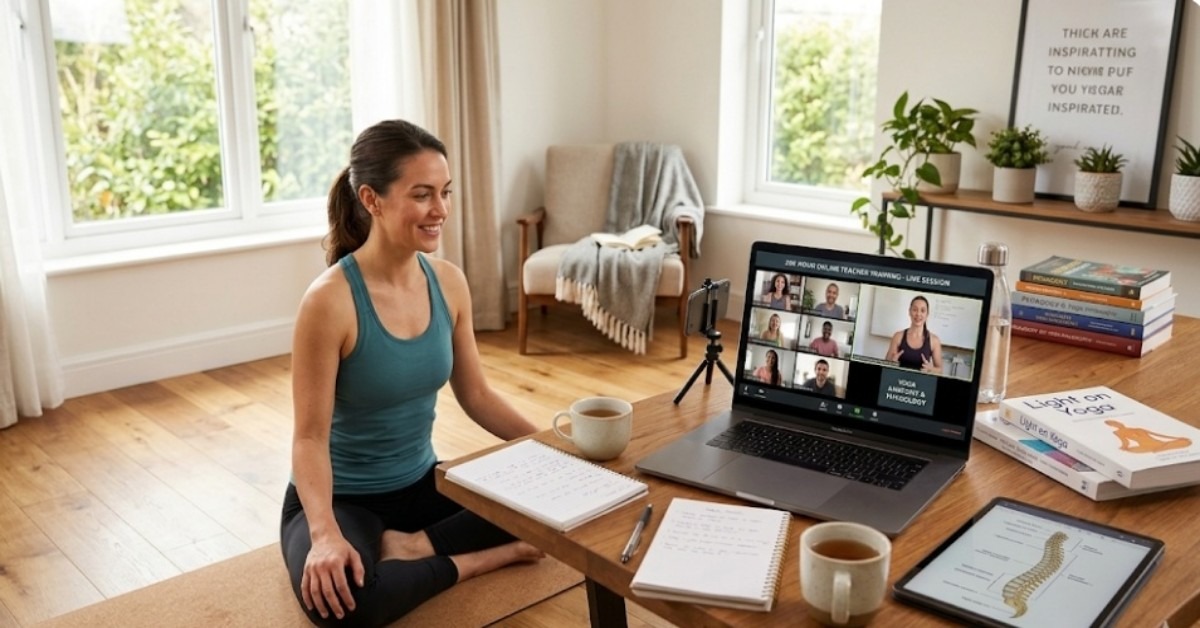
You might secretly doubt, Can I really teach after learning from a screen?
That doubt is completely okay. Many students hesitate after completing an online Yin yoga teacher training, which requires physical presence, hands-on corrections, and years of confidence.
But Yin doesn’t work like that.
Yin is not about adjusting your body into perfect shape. It is about guiding people to safe stillness, helping them to know their limits, and creating space where they are not forced into anything. And this is what you learn during your online Yin training.
If you have completed a 200-hour online teacher training, you already carry all the skills needed to teach Yin safely. You simply need a strong nudge and confidence to start.
Teaching Yin is less about doing more and proving yourself and more about knowing what not to do.
Here is how you can step into teaching Yin with unshakable confidence.
1. Start By Removing The Fear Of “Hands-On-Adjustment
One of the biggest myths is that yoga teaching depends on physical adjustments. Yin rarely needs that.
In fact, too many adjustments can create disturbance in your Yin practice.
Yin only needs clear verbal instructions and reassurance that they are allowed to stay within comfort.
This is why students from online Yin yoga teacher training are often trained to explain poses clearly without touching. Your words become the biggest support system in teaching Yin.
2. Teach Sensation, Not Shape
In many yoga styles, teachers focus on how the posture looks. In Yin, what matters is how the posture feels.
You don’t focus on making it look correct; you work on how it makes them feel.
Your role is to guide students toward safe sensations in the target area of the body without pushing intensity or their boundaries.
This understanding is strongly developed during the 200-hour online teacher training for Yin, where theories and joint safety are explained in detail.
When students focus on sensation, the risk of injury decreases.
3. Use Props As Safety Tools, Not Accessories
Bolsters, cushions, blocks, and blankets are not optional in Yin. They are a part of safe Yin teaching.
Encourage students to use more support than they think they need. A supported pose held for five minutes is far safer and more effective than a deep pose held while going through the pain.
This prop-based teaching style is the most important part of online yin yoga teacher training, and it becomes your safety technique when you start your own teaching sessions.
4. Offer Exit Options Before Students Need Them
Instead of waiting for discomfort to happen, teach students how to come out of a pose beforehand.
Using simple instructions like:
If you feel tingling or any sharp sensation, try to slowly come out.
This helps to create awareness and responsibility for their own safety in students.
This reduces dependence on you and increases their body awareness.
5. Respect Individual Differences
Everybody is different in their ability to hold poses, bear the strain, and holding their breath.
Yin teaching is safe only when you expect nobody to go at the same intensity.
Your training teaches you about joint variation and fascia response. Apply that knowledge, allow different versions of the same pose without correcting them into one “ideal” shape.
6. Keep Transitions Slow and Mindful
Most painful moments in Yin happen not during holding the pose but during the entry and exit of the pose.
Teach students to enter slowly, settle gently, and come out even slower. This protects joints and allows the body to respond safely after holding the pose.
This transition is something you have lately observed during online yin yoga teacher training, and now it has become a strong tool in your teaching.
7. Build Silence Into Your Teaching
You don’t need to keep talking all the time.
Give instructions, then let silence lead the class because Yin works in stillness; too many words can create mental tension.
Your calm presence is a part of safety. When students feel relaxed mentally, they stop forcing themselves to strain their bodies.
8. Watch For Breath, Not Depth
If a student’s breath is uneven while doing Yin practice, they have gone too far.
This is an easier safety indicator than observing their flexibility. Remind them to maintain soft and natural breathing. If breath struggles at a moment, then they need to reduce intensity.
This awareness becomes natural after completing a 200-hour online teacher training where breath-body connection is essential.
9. End Every Pose With Neutral Time
After each long hold, give students time to absorb the effects of the pose and prevent dizziness or pain in joints.
Never rush from one pose to another.
Teaching Yin With Confidence and Extra Care
Teaching Yin safely is about guiding, observing, and allowing.
You don’t need to force, no need to force perfection. You just need patience and clarity.
Your online Yin yoga teacher training has already prepared you for this gentle style of teaching, where awareness is more important than performing well.
If you ever feel that you are unsure or not ready, return to the basics you learned.
At Nirvana Yoga School, students of online programs are taught in a way that builds both understanding and teaching skills. And once you begin, you realise that:
You were ready to teach before you believed you were.