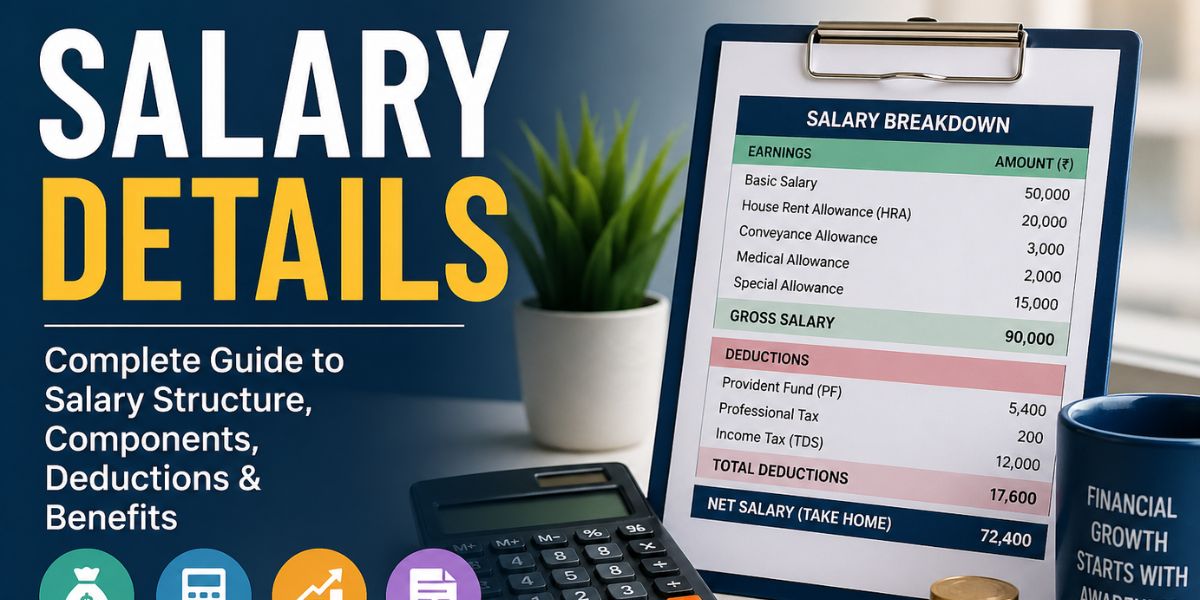
Salary breakdowns are important for every working professional, whether you are a fresher emerging into the job market or an experienced professional looking to grow in your career. Understanding how your salary is structured helps you make financial decisions better, optimise tax savings and assess each job offer well. The comprehensive guide to everything home about salary details including the components of salary, how deductions work, benefits that you can get and ways to calculating your take home.
What Are Salary Details?
Salary/Fix– This is a detailed salary structure of an employee including the fixed pay, variable pay, full breakdown on the allowances and deductions. It is generally prescribed in the salary slip or offer letter where you have a clearer insight into what you earn and what you take home.
A typical salary structure includes:
- Basic Salary
- Allowances
- Bonuses
- Deductions
- Net Salary (Take-Home Salary)
Key Components of Salary Details
To understand salary details properly, it is important to know each component in depth.
1. Basic Salary
The basic salary is the core component of your salary. It usually forms 40% to 50% of the total salary package.
- Fixed amount
- Forms the base for calculating other components
- Fully taxable
2. House Rent Allowance (HRA)
HRA is provided to employees to cover rental expenses.
- Depends on salary and city of residence
- Offers tax benefits under certain conditions
- Higher for metro cities
3. Dearness Allowance (DA)
DA is mainly applicable to government employees.
- Helps manage inflation
- Calculated as a percentage of basic salary
- Fully taxable
4. Conveyance Allowance
Given to cover travel expenses between home and workplace.
- Fixed monthly amount
- Partially tax-exempt within limits
5. Medical Allowance
Covers medical expenses.
- Fixed amount in salary
- Taxable unless supported by bills under reimbursement schemes
6. Special Allowance
This is a flexible component added to balance the salary structure.
- Fully taxable
- No specific purpose
7. Bonus and Incentives
Performance-based payments.
- Paid annually or quarterly
- Fully taxable
- Not fixed
Read More: SSC JE Basic Pay / UPSC Salary / Constable Salary / IBPS Clerk
Salary Structure Table
Below is a simple table showing a typical salary structure:
| Component | Percentage/Amount | Taxability |
|---|---|---|
| Basic Salary | 40% – 50% | Fully Taxable |
| HRA | 20% – 30% | Partially Tax-Free |
| Conveyance Allowance | Fixed | Partially Tax-Free |
| Medical Allowance | Fixed | Taxable |
| Special Allowance | Variable | Fully Taxable |
| Bonus/Incentives | Variable | Fully Taxable |
Understanding Salary Deductions
To fully understand salary details, you must also know about deductions that reduce your take-home salary.
1. Provident Fund (PF)
- 12% of basic salary
- Equal contribution by employer
- Long-term savings
2. Professional Tax
- Charged by state government
- Small monthly deduction
- Varies by state
3. Income Tax (TDS)
- Based on income slab
- Deducted monthly
- Adjusted annually
4. Employee State Insurance (ESI)
- Applicable for lower-income employees
- Provides medical benefits
Gross Salary vs Net Salary
Understanding the difference is crucial when analyzing salary details.
| Type | Meaning |
|---|---|
| Gross Salary | Total earnings before deductions |
| Net Salary | Final take-home salary after deductions |
Formula:
Net Salary = Gross Salary – Total Deductions
Example of Salary Calculation
| Component | Amount (₹) |
|---|---|
| Basic Salary | 25,000 |
| HRA | 10,000 |
| Allowances | 5,000 |
| Gross Salary | 40,000 |
| PF Deduction | 3,000 |
| Tax Deduction | 2,000 |
| Net Salary | 35,000 |
Importance of Understanding Salary Details
Knowing your salary details helps you:
- Plan monthly expenses effectively
- Save taxes legally
- Compare job offers accurately
- Negotiate better salary packages
- Track financial growth
Salary Details in Different Sectors
Government Jobs
- Fixed salary structure
- Includes DA, HRA, pension
- High job security
Private Sector Jobs
- Flexible salary structure
- Performance-based incentives
- Higher growth opportunities
How to Read a Salary Slip
A salary slip is a monthly document that shows your salary details. It includes:
- Employee information
- Pay period
- Earnings section
- Deductions section
- Net salary
Tips to Optimize Your Salary
To make the most of your salary details, follow these strategies:
- Choose tax-saving investments
- Opt for reimbursements instead of allowances
- Increase PF contribution for long-term savings
- Use HRA benefits effectively
Common Mistakes to Avoid
While reviewing salary details, avoid these mistakes:
- Ignoring deductions
- Not checking tax implications
- Overlooking hidden benefits
- Accepting offers without breakdown
Future Trends in Salary Structure
Modern salary structures are evolving with:
- Flexible benefits
- Remote work allowances
- Performance-based pay
- Digital salary management systems
Conclusion
Having a good grip over the salary details can save one from many future troubles when it comes to financial stability and growing their careers. Knowing these should help you be able to deconstruct everything, know every deduction and benefit that is factored in so that you can make the best decision possible to maximize your earnings. You always have to scrutinise your salary structure and plan for the long term.
FAQs
1. What are salary details?
Salary details refer to the complete breakdown of an employee’s earnings, including basic salary, allowances, bonuses, and deductions. It helps employees understand how their total salary is structured and how much they actually receive as take-home pay.
2. What is the difference between gross salary and net salary?
Gross salary is the total amount earned before any deductions, while net salary is the final amount received after deductions like tax, provident fund, and other contributions.
3. What is included in salary details?
Salary details usually include:
Basic salary
House Rent Allowance (HRA)
Dearness Allowance (DA)
Special allowances
Bonuses and incentives
Deductions like PF, tax, and professional tax
4. How is net salary calculated?
Net salary is calculated by subtracting total deductions from gross salary.
Formula:
Net Salary = Gross Salary – Deductions
5. What is basic salary in salary details?
The basic salary is the fixed core part of your salary. It is used to calculate other components like HRA, PF, and bonuses, and is usually 40–50% of the total salary.
.