
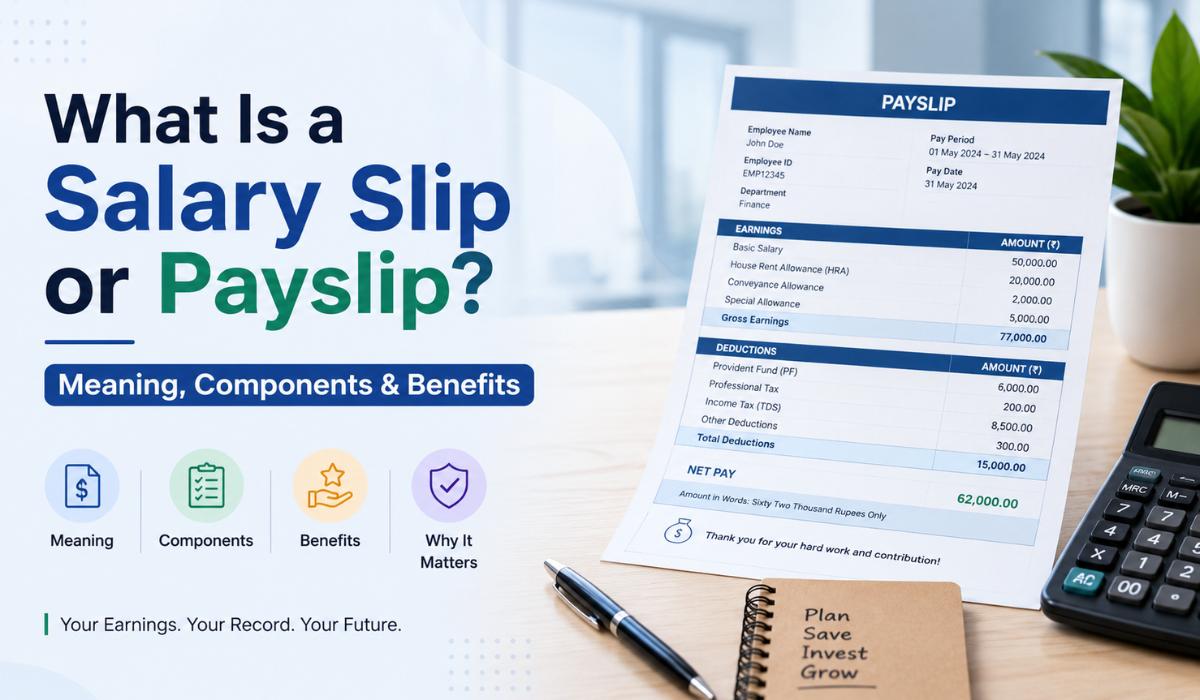
What Is a Salary Slip or Payslip? A salary slip or payslip is one of the most important financial documents for an employee. A salary slip is a detailed, itemised account of an employee’s earnings, allowances and deductions for the given pay period and is mandatory every month, issued by the employer. Other than the obvious question of how much you earned, knowing your salary slip has a huge impact on your tax planning, loan eligibility and overall financial decisions throughout the year.
However, you are either new to the job and stepping into your first company or experienced with multiple sources of income; reading a salary slip helps you to fine-tune according to your taste. This article is a complete guide to understanding what this document is, why it matters, its contents and how you can leverage it effectively.
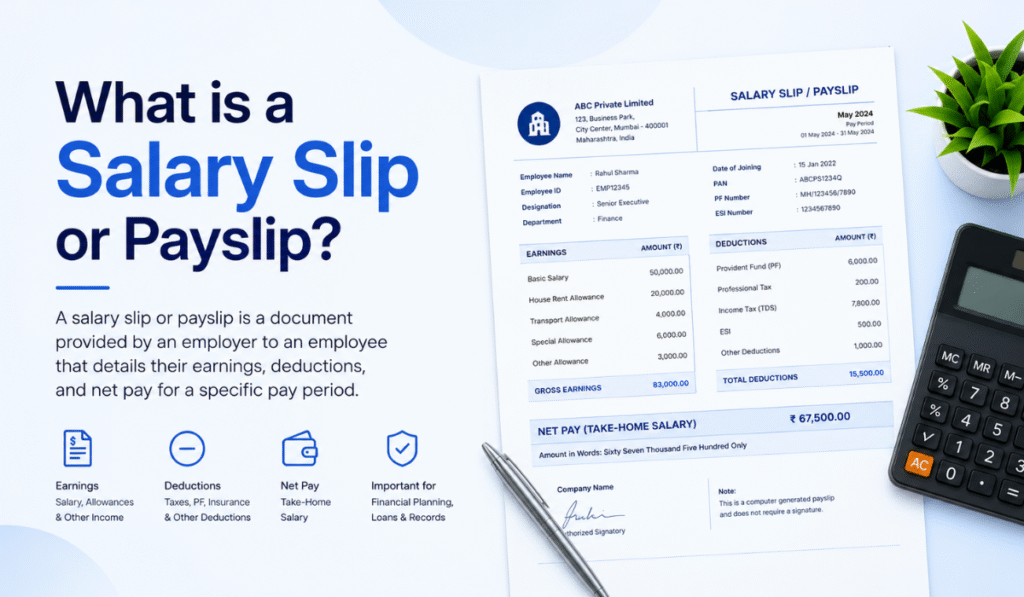
What is a Salary Slip or Payslip?
A salary slip (payslip/chalan/pay stub) is a record issued by an employer to each employee at the end of every pay cycle, usually monthly. The salary slip is a detailed account of all the components that make up your pay: gross earnings (how much you earned before deductions), statutory and voluntary deductions (what was deducted), and net salary (the amount actually credited to your bank).
Salary slips are issued in hard copies and digital formats in India. The majority of modern organisations either use HRMS (Human Resource Management Systems) or payroll software to automatically generate salary slips, which employees can easily download as PDF files from their company portals. A salary slip is a kind of record in the financial books of the employee and is used as an official document for payroll compliance by an employer.
Why is a Salary Slip Important?
A salary slip serves a purpose that goes much further than just confirming your monthly income. Below are some key reasons why every employee should hold their salary slips carefully:
- For Loans and Credit cards – Proof of income – Banks/NBFCs demand the last 3 to 6 months’ salary slips as proof of income while applying for a home loan, personal loan, car loan or credit card.
- Tax Filing and TDS Verification: A salary slip indicates how much TDS is deducted from your income every month, and you will cross-check the same with the Form 16 while filing income tax.
- Lease Agreements: Most landlords want salary slips to ensure that a tenant can afford the rent with regular monthly income.
- Visa and Travel Applications: Foreign consulates and embassies regularly require recent salary slips to demonstrate the finances of those applying for visas.
- Salary Negotiations: When you negotiate your compensation with a new employer, salary slips from the company you are currently working in will also be considered base on which the salary by the new employer is negotiated.
EPF and ESI-You can check if what was deducted from your salary is being credited to PF and ESI accounts correctly or not by simply checking with a salary slip.
Read Also: Axis Bank Tallyman: Meaning, Purpose, Calls,
Key Components of a Salary Slip
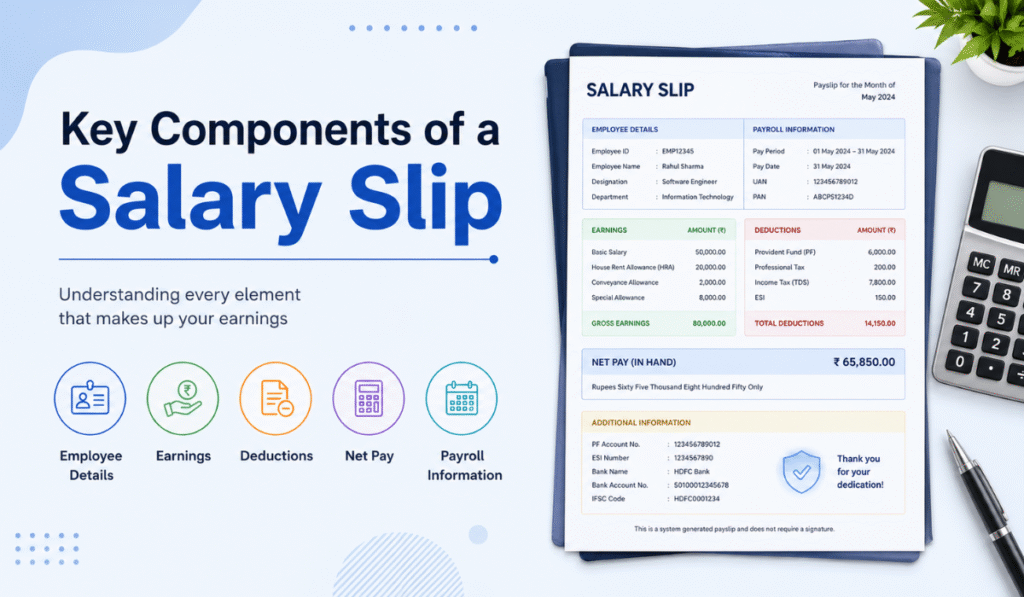
There are two main sections in a salary slip or pay slip: Earnings and Deductions. Here is a concise table providing information about the various details appearing in an Indian salary slip.
| Component | Type | Description |
| Basic Salary | Earnings | Fixed core pay, usually 35–50% of CTC |
| House Rent Allowance (HRA) | Earnings | Allowance for rented accommodation; partly tax-exempt |
| Dearness Allowance (DA) | Earnings | Inflation-linked allowance, common in government jobs |
| Conveyance Allowance | Earnings | Covers daily travel expenses to and from work |
| Medical Allowance | Earnings | Fixed amount for medical expenses each month |
| Special Allowance | Earnings | Variable component to bridge CTC and gross salary |
| Performance Bonus | Earnings | Merit-based incentive paid monthly or quarterly |
| Provident Fund (PF) | Deductions | 12% of basic salary deducted; employer contributes equally |
| Professional Tax (PT) | Deductions | State-levied tax; varies by state and income slab |
| Tax Deducted at Source (TDS) | Deductions | Income tax deducted based on annual tax liability |
| Employee State Insurance (ESI) | Deductions | 0.75% deduction for employees with gross ≤ ₹21,000/month |
The above components can differ from industry to region, company policy, as well as public vs private sector. DA and a slew of allowances not found on private-sector payslips are more common for Gov employees.
Sample Salary Slip Breakdown
A salary slip explained an example of a payslip for an Indian Employee in Number ₹60000 as a monthly CTC for mid-level employees.
| Earnings | Amount (₹) |
| Basic Salary | 25,000 |
| HRA | 10,000 |
| Conveyance Allowance | 1,600 |
| Medical Allowance | 1,250 |
| Special Allowance | 7,150 |
| Gross Earnings | 45,000 |
| Deductions | Amount (₹) |
| Provident Fund (Employee) | 3,000 |
| Professional Tax | 200 |
| TDS (Income Tax) | 1,800 |
| Total Deductions | 5,000 |
| Net Salary (Take-Home) | 40,000 |
For example, in the above sample, the gross pay of that employee is ₹45,000, where ₹5,000 has been deducted as PF + professional tax + TDS=₹40,000 (Take-home = Gross Salary − deduction amount). The other 15,000 of CTC is nothing but the employer’s EPF contribution, gratuity and a few indirect benefits that won’t show up on the free salary slip.
CTC vs Gross Salary vs Net Salary
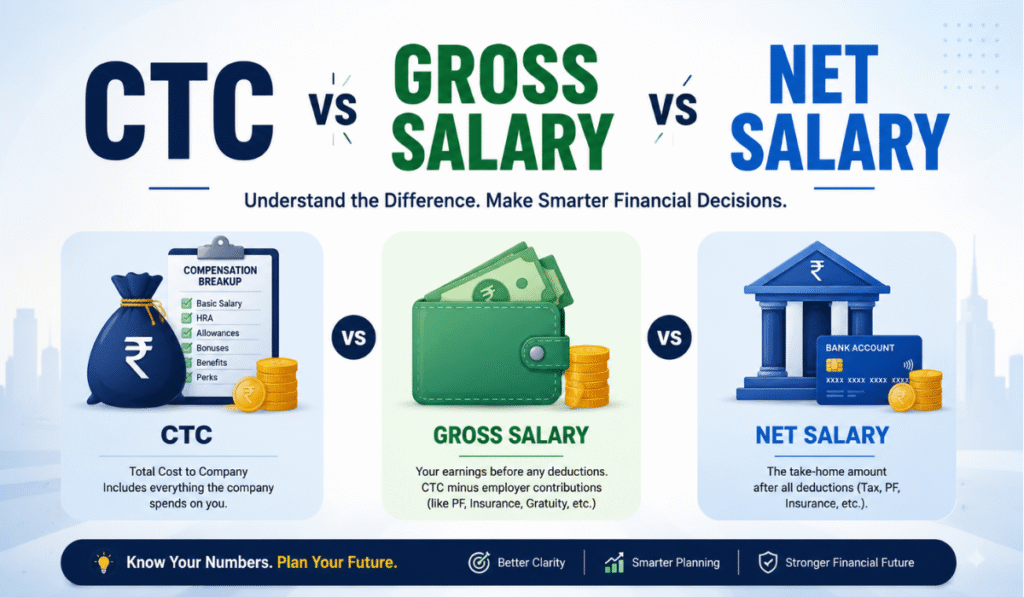
CTC, gross salary and net salary are three terms that many employees confuse. These are three different tigers, and your salary slip is the one that helps clear these waters for you:
| Term | What It Includes | Example (₹/month) |
| CTC (Cost to Company) | All direct + indirect costs borne by employer | 60,000 |
| Gross Salary | All cash components before deductions | 45,000 |
| Net Salary | Take-home pay after all deductions | 40,000 |
CTC can include portions of the salary, such as employer PF contributions, gratuity provisions, and medical insurance premiums, but your basic salary slip only prints gross salary and net income.
Read Also: 80GG of Income Tax Act: Eligibility, Benefits and Claim Process
How to Read a Salary Slip Step by Step
Though reading a salary slip can be strangely intimidating at first glance, it gets easier if you break down the structure. Below is a detailed guide on reading your salary slip:
Stage 1: Verification Of Personal And Ancillary Details
All pay slips start with some basic identification details: your name, employee ID, department, designation and the employer’s name and address. This is only confirmed information; check it to ensure that the slip is generated correctly for you.
Step 2: Verify the Pay Period
View the salary slip for the month and year. The pay period dates and working days will assist you in checking if your salary has been calculated pro-rata if you joined mid-month or took LWP.
Step 3: Review Earnings
Proceed with every component of earnings: basic salary, HRA, DA, conveyance and special allowances. Make sure these are in accordance with what was mentioned in your offer letter or last salary revision letter. HR should be notified immediately if there is any discrepancy.
Step 4: Check Deductions
In the deductions section, you will see EPF, ESI (if applicable), TDS and professional tax. Check that PF Deduction is 12% of your basic salary. If the TDS looks unusually high, then you can submit investment proofs to your employer and have it reduced.
Step 5: The first thing to do is to verify the Net Salary
You would compare the net sum listed at the bottom of the salary slip to that credited in your bank account. In case of discrepancy, it can be either an advance recovery, a delayed penalty or a manual adjustment that is not well marked on the slip;
HRA and Tax Benefits Visible on a Salary Slip
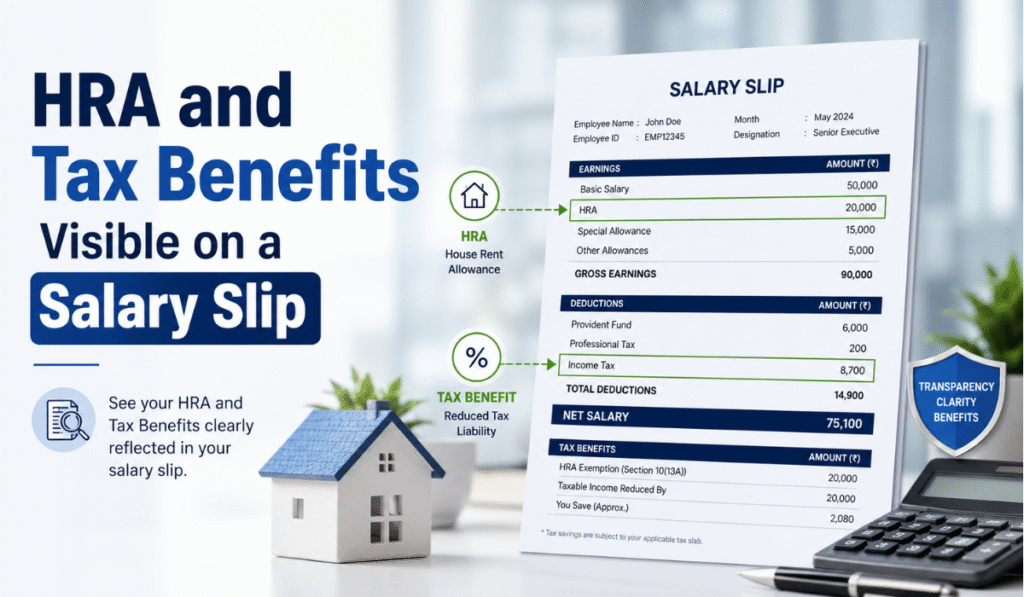
One of the major and critical tax-saving factors on your salary slip is House Rent Allowance (HRA). HRA exemption under Section 10 (13A) of the Income Tax Act is available to salaried persons living in rented accommodation.
HRA EXEMPT The exempt part of HRA will be the least of:
- Actual HRA received as reflected in your salary slip
- 50% of Basic Salary in Metro Cities (40% Rest Non-Metro)
- Rent actually paid, deduct 10% of basic salary
Various allowances such as conveyance (up to ₹1,600/month) and medical allowance (up to ₹15,000/year under the old tax regime) also have a component that is exempt. With a salary slip, you can know and explore these exemptions when filling out your income tax return.
Digital Salary Slips and HRMS Portals
Most of the employees these days access their salary slips in electronic form with the huge number of online payslip management services in India today. Companies create and share the salary slips from platforms like Keka HR, Darwinbox, GreytHR, Razorpay Payroll & SAP SuccessFactors. An employee can sign in to his or her own HRMS portal and go to the payroll or pay slip option and download their monthly salary slip that is saved as a password-protected PDF.
Digital salary slips are the same legal documents, and they have been recognised by banks, financial institutions and government offices in the same regard as physical salary slips. Save at least the last 12 months’ worth of salary slips you are trained on, as doing these jobs for loan applications, tax filing or switching between jobs will be easy for you if you have saved your payloads from months.
Read Also: SDM Full Form: Meaning, Eligibility, Salary And More
Do Freelancers or Self-Employed Individuals Get a Salary Slip?
Salary slips are a privilege only for salaried employees who have an employer-employee relationship. Freelancers, consultants self-employed do not have a salary slip since they are not on the payroll of any organisation. Instead, they are using bank statements, income tax returns (ITRs), Form 26AS, audited profit-and-loss statements and invoices as income proof.
If a consultant is appointed on contract through the company, then the company can raise a service fee report or payment voucher, but a salary slip or payslip will not be there. Self-employed people, for instance, usually must furnish a wider array of financial documents needed for loans, insurance and paperwork.
Conclusion About What is a Salary Slip or Payslip
A salary slip or payslip is a lot more than just a customary monthly document; it is an important financial record that validates salary and supports tax compliance, income verification, and personal finance management.
At the same time, once you are aware of each component of your salary slip, you can pick out where to save on taxes, spot incorrect statutory contributions, and check if your employer is paying you correctly. You can be applying for a home loan or filing your Income Tax Return (ITR) or planning for your yearly finances, a salary slip is the most powerful document in your financial toolkit. You should get into the habit of checking your salary slip every month, and keep copies for at least 3 years.
Frequently Asked Questions (FAQs): What is a Salary Slip or Payslip
Q1. Definition of a salary slip or payslip?
A salary slip or payslip is an official record issued by an employer to its employee every month. It shows how the gross earnings are calculated, itemised allowances, statutory deductions and finally the net (take home) salary deposited into the bank account of the employee.
Q2. A salary slip is not a statutory requirement.
There is no central law on paying salary slips, but many state-specific labour laws and the Payment of Wages Act also impose liabilities on the employer to maintain records of wages. Standard HR & Compliance practice. Most companies use salary slips as an HR and compliance practice.
Q3. Is a salary slip as proof of income acceptable?
Yes, one of the most widely accepted income proof documents in India is a salary slip. Recent salary slips (usually for a maximum of 3 months) are required by banks, NBFCs, landlords and visa officers to ascertain an individual’s income and ability to repay.
Q4. Now, the main difference between gross salary and net salary in a salary slip is?
Ans: Gross salary is the total earnings, which include basic pay, HRA and other allowances before any deductions. When talking about the take-home pay structure, an employee’s net salary is the sum that will be credited to his or her bank account after all deductions (PF, TDS and professional tax).
Q5. When I want to download or obtain my payslip?
Most companies have salary slips through their HRMS or payroll portals (Razorpay Payroll, Keka, Darwinbox, etc. Employees are able to log in and click to download their payslip for the month as a PDF. In case there is no portal at hand, then the HR or accounts department can send it to you by post or email.
Q6. What is the difference between a salary slip and a salary certificate?
No. A salary slip is a monthly document indicating the pay breakdown in detail. A salary certificate is a distinct official written statement issued by the employer that summarises the employee’s work status, designation (job title) and annual or monthly salary, generally asked for loans/visa applications.
Q7. What are the deductions shown in a salary slip?
A: Any standard payslip will include statutory deductions such as EPF/PF, PT, TDS and ESI wherever applicable. Separately, some entities additionally disclose voluntary deductions similar to loans or advances.
Q8. How can the salary slip be utilised for income tax returns?
Ans: Yes. The salary slip gives important figures that are required when filing an ITR: gross income, HRA received, and TDS amount deducted. Nevertheless, Form 16 provided by the employer at the end of the year is a definitive document for ITR filing and TDS reconciliation.
Read Also: Salary Details Guide: Structure, Components, and Calculation